

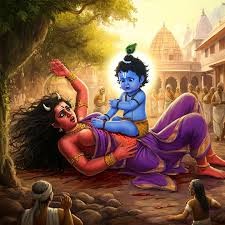
According to the Śrīmad Bhāgavatam, many miraculous and extraordinary events took place during the childhood of Lord Krishna. Among these, one of the most fascinating and significant pastimes was the slaying of the demoness Putana.
Kansa, fearing his sister Devaki’s eighth son—because he had learned through a divine voice (Akashvani) that this child would be the cause of his destruction—sent many wicked demons to eliminate his foe. One of these demons was Putana, a powerful and malevolent rakshasi (demoness) who possessed extraordinary magical powers.
Putana had the ability to take any form she desired. Using her illusionary powers, she devised a wicked plan to enter Gokul and deceive the women and children there. She disguised herself as a beautiful, ordinary woman to gain the trust of everyone. Her sole purpose was to kill the newborn Lord Krishna by feeding him her poisonous breast milk.
Slowly and carefully, Putana began executing her evil plan. She entered the village of Gokul and assumed the form of a beautiful woman, blending perfectly among the villagers. Everyone believed she was harmless. She presented herself so convincingly that not a single person suspected her true identity.
However, Lord Krishna, who was the divine incarnation of Lord Vishnu, recognized her evil intentions immediately. As Putana lifted the newborn Krishna in her arms and began feeding him her poisonous milk, Krishna did not drink it like a normal child.
Instead, using His divine and supernatural power, Krishna drew Putana’s life force into Himself. Putana was shocked and furious. She attempted to revert to her true terrifying form, but the tiny Lord Krishna, with His miraculous strength, held onto her chest so firmly that she could not escape.
In a rage, Putana tried to fly into the sky, screaming loudly, but before Krishna’s divine power, all her magical and evil strength was destroyed. Ultimately, she fell lifeless to the ground.
As Putana collapsed, her true rakshasi form became visible—gigantic, terrifying, and grotesque. The villagers of Gokul were awestruck and filled with fear at the sight. Yet, the divine presence of baby Krishna pacified the frightening scene.
The people of Gokul witnessed this extraordinary event and realized in their hearts that Lord Krishna’s divine play (lila) is a manifestation of infinite power and the triumph of righteousness (dharma) over evil. The incident clearly conveyed that no matter how powerful or cunning evil may appear, it is destined to be destroyed before truth and dharma.
The slaying of Putana is considered one of the most important pastimes of Krishna’s childhood. It not only demonstrates His divine power but also symbolizes that God protects His devotees in every situation. The miraculous act of baby Krishna left the villagers inspired, amazed, and filled with devotion.
Thus, the Putana Vadh is not just a remarkable event but also a profound symbol of the end of evil and the eternal victory of righteousness. Among Krishna’s childhood pastimes, this story has always served as an inspiring lesson for devotees and storytellers alike, illustrating the divine protection, strength, and supreme power of the Lord.
