

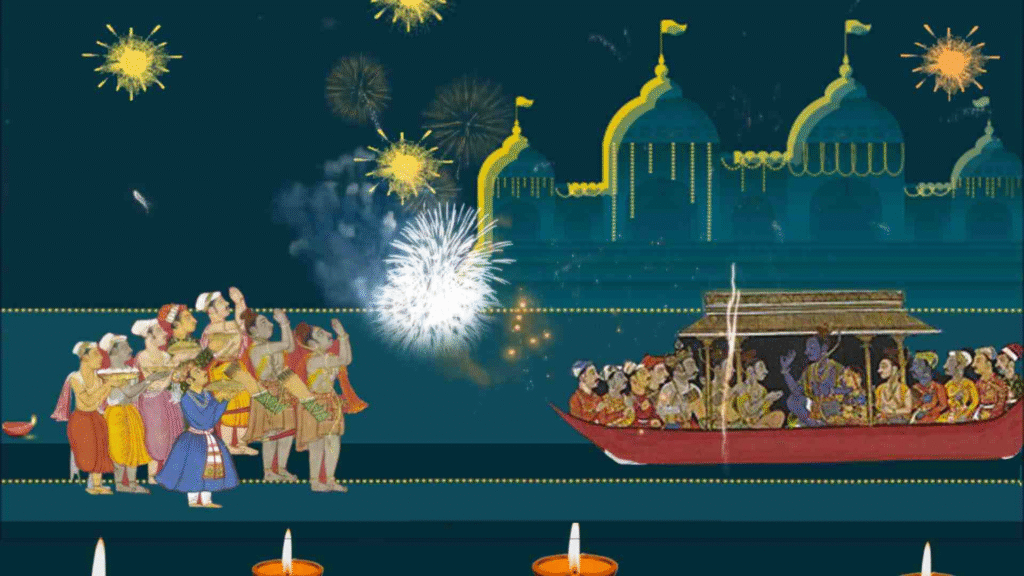
Diwali is the pride of Indian culture because it is the festival of lights — and the lamp (diya) is a symbol of illumination that dispels darkness. This small clay lamp is not only a source of light but also a profound teacher of life. It symbolizes simplicity, humility, purpose, and perseverance. Though made of clay, the diya embodies the ideals of our existence, guiding us toward righteousness, inspiring resolve, and lighting the path toward our ultimate goals.
The true essence of celebrating Diwali lies in dispelling the darkness within. Darkness represents the problems of life, while light signifies their solution. To live meaningfully, one needs inner illumination. Since ancient times, humankind’s deepest quest has been the pursuit of light.
Diwali, though one festival, carries many meanings and interpretations. Every Indian celebrates it with great enthusiasm and devotion. It is not only significant from a religious point of view but also from spiritual, cultural, and moral perspectives.
- It is the day of Nirvana of Lord Mahavira.
- It is the festival of lights celebrating Lord Rama’s return to Ayodhya after defeating the demonic forces.
- It is the night of worship dedicated to Goddess Kali, symbolizing the triumph of Shakti (divine power).
- It is the day of worshipping Goddess Lakshmi, the goddess of wealth, fortune, and prosperity.
- It is the festival of abundance, auspiciousness, and joy, marking the beauty and richness of Indian civilization.
This festival is deeply rooted in the veins of every Indian. Those great souls who have discovered their inner light have become luminous themselves — illuminating others with their divine glow. The ones who awakened their inner strength became fountains of infinite power, and those who celebrated the Diwali within inspired the world to celebrate Diwali in their honor.
Indeed, humankind has always been drawn toward light. Darkness was never desired nor prayed for. The ancient prayer “Tamso ma jyotirgamaya” — “Lead me from darkness to light” — reflects this eternal yearning of the soul. Man has always sought the lamp that could guide his journey toward the ultimate goal.
A person surrounded by darkness becomes directionless; no matter how fast he moves, his journey remains meaningless. Therefore, before righteous conduct, knowledge is essential — for knowledge is the true light of life. Scriptures declare, “Nāṇam payāsayaram,” meaning knowledge itself is illumination. Darkness symbolizes ignorance, immorality, laziness, hatred, anger, greed, and violence — the demonic tendencies within us.
When such negative forces arise within a person, the environment becomes clouded with gloom and despair. Humanity cries out in anguish, seeking guidance. At such times, what one needs is a beacon of light — a guiding force that can lead from confusion to clarity. And so, humanity prays:
“Lead us from darkness to light,
From evil to goodness,
From death to immortality.”
This prayer expresses our devotion to truth, virtue, and immortality — inspiring us to live an ideal life.
Light symbolizes virtue, wisdom, compassion, love, tolerance, peace, and prosperity. When this light awakens within the human consciousness, the world itself begins to transform — as though the golden age has descended upon earth.
Every person has an eternal flame burning within. At times, its glow may dim, but it never dies out. Its brilliance is eternal and divine. As the saint Kabir once said:
“Nothing is visible outside,
For the true light burns within.”
Diwali, therefore, is not merely a festival of lamps; it is a festival of awakening, a celebration of self-realization, and a reminder to purify our aura and inner world. It connects the outer illumination to the inner awakening.
Even though Diwali has become a grand cultural celebration in society, its essence remains deeply spiritual. It is a festival that bridges the worldly and the divine — reminding us that the light of knowledge alone can dispel the darkness of ignorance.
The darkness within — of greed, attachment, and illusion — can be removed only through the lamp of knowledge and righteousness. When this light shines within, both the inner and outer worlds become radiant, and the empire of darkness dissolves on its own.
In today’s age, humanity faces the shadows of terrorism, violence, pollution, immorality, and fear. All these are creations of human ignorance and desire. Only when humans renounce unnecessary violence and awaken the spirit of compassion can peace return to the world.
To dispel the darkness of delusion, we must light the lamp of dharma (righteousness). Where the sun of righteousness rises, darkness cannot remain.
There is a story — once, Darkness complained to Lord Brahma that the Sun constantly chased and destroyed it. When Brahma asked the Sun about this, the Sun replied, “I have never even seen Darkness; how can I destroy it? Bring it before me.” But Darkness said, “How can I come before the Sun? The moment I appear, I shall cease to exist.”
This story beautifully reveals that light does not fight darkness — it simply exists, and darkness disappears on its own.
Thus, Diwali should not merely be about lighting external lamps; it should be a time to light the inner lamps of consciousness. Just as we clean and decorate our homes for Diwali, we must also sweep away the dust of ignorance and negativity from the courtyard of our hearts — and kindle within it the eternal flame of the soul. In doing so, one attains true peace, happiness, and fulfillment.
The great philosopher Acharya Mahapragya once said:
“If you wish to understand religion, the inner self, and the true light, you must first learn to close your senses. Close your eyes, ears, and mouth — and turn inward.
When you stop watching the outer drama, you begin to experience the infinite beauty of the inner world. Practice this regularly, and one day you will witness a divine light within — vast, blissful, and radiant, where no darkness or problem exists.”
The true meaning of Diwali lies in lighting both outer and inner lamps. Wherever a lamp is lit, it spreads only light. Its message is clear — never run away from life; transform it. Because escape breeds weakness, but transformation creates growth.
Ultimately, the lamp stands as a challenge to those who live idly and directionlessly — dreaming of success without effort. The diya teaches us that only by burning away our weaknesses can we illuminate our destiny.
