

In the Dwapara Yuga, a celestial prophecy was heard in the royal court of Mathura. The divine voice declared:
“O King Kansa! Beware. The eighth son born to your sister Devaki will be the cause of your death.”
This prophecy struck terror deep into the heart of the tyrant Kansa. Though he was powerful, cruel, and feared by all, the certainty of his own death haunted him constantly. From that moment onward, his life became a restless search for ways to avoid his fate.
Kansa imprisoned his own sister Devaki and her husband Vasudeva, and one by one, he slew their children at birth. Yet the divine plan could not be stopped. When the eighth child, Krishna, was born, by divine arrangement Vasudeva carried the infant safely across the Yamuna River to Gokul, where he grew up under the loving care of Nanda and Yashoda.
Though hidden in Vrindavan, Krishna’s fame began to spread. The slaying of demons like Putana, Trinavarta, and Aghasura all reached the ears of Kansa. Each report confirmed his fear—the boy was no ordinary child, but the very threat the prophecy had spoken of.
Kansa’s fear soon turned into obsession. He thought day and night of how to kill Krishna. At last, he devised a cunning plan. He announced a grand festival of wrestling and celebration in Mathura. Under this pretext, he would summon Krishna and His elder brother Balarama to his city and arrange for their deaths.
To carry this invitation, Kansa sent the noble messenger Akrura, who was secretly a great devotee of Krishna. Akrura gladly went to Gokul, and when he informed Krishna and Balarama of the invitation, the two divine brothers accepted with joy. They knew the time had come to end the tyranny of Kansa.
When Krishna and Balarama arrived at the gates of Mathura, Kansa had already prepared deadly obstacles. At the entrance, he placed his ferocious royal elephant, Kuvalayapeeda, with strict orders to trample the two boys to death. The mahout (elephant-keeper) was instructed to unleash the beast upon their arrival.
As the brothers approached, the massive elephant charged forward, trumpeting loudly, with eyes burning in rage. The crowd gasped in fear. But Krishna walked calmly towards it, his eyes shining like lightning.
When Kuvalayapeeda tried to seize Him with its trunk, Krishna caught hold of the trunk and struck the beast with effortless might. The great elephant stumbled. Then Krishna leapt upon it, and with a gentle slap upon its head, ended its life. The enormous beast fell dead at the gate, and the people of Mathura were astonished at the divine power of the youthful Krishna.
Humiliated that his first trap had failed, Kansa called forth his strongest wrestlers—Chanura and Mushtika. These were no ordinary fighters; they were renowned throughout the kingdom for their unmatched strength and skill in wrestling. Kansa ordered them to fight against Krishna and Balarama in the royal arena.
Thousands of people gathered to witness the contest. The air was filled with tension as drums resounded, and the wrestlers entered the arena with pride.
The match began. Chanura charged at Krishna, while Mushtika faced Balarama.
Krishna seized Chanura by both arms, lifted him into the air, and whirled him around with lightning speed. With one mighty throw, He dashed him to the ground. The force was so great that Chanura’s life left his body at once.
At the same time, Balarama struck Mushtika with a thunderous blow of his fist. Blood gushed from Mushtika’s mouth, and he collapsed lifeless upon the ground.
The arena erupted with cries of joy. The people of Mathura, long oppressed under Kansa’s rule, shouted in triumph:
“Victory to Krishna! Victory to Balarama!”
Kansa was burning with rage. His plans had failed one after another—his elephant slain, his wrestlers dead, and the crowd cheering for Krishna. Unable to control his fury, he stood up in his royal seat and roared:
“Seize them! Kill them at once! Soldiers, do not delay—tear them to pieces!”
But the people of the Yadava clan, loyal to Krishna, rose up against the king’s soldiers. Chaos broke out in the arena. Cries and shouts filled the air.
Then Kansa himself, blinded by anger, drew his sword. He prepared to strike down Krishna with his own hands.
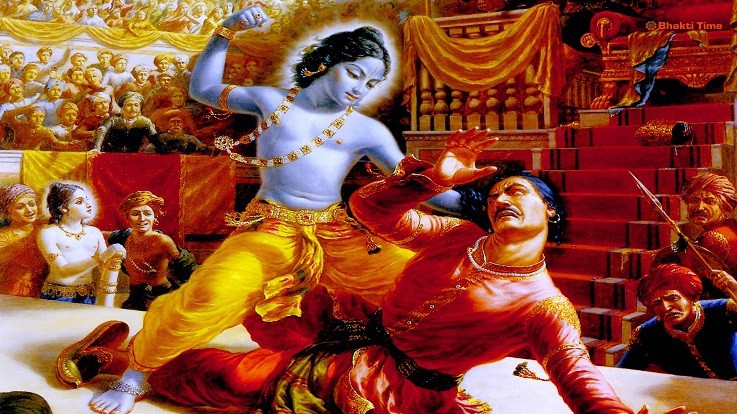
Before Kansa could act, Krishna leapt from the wrestling ground to the royal platform in a single bound. The tyrant king had no time to react. Krishna seized him by the hair, pulled him from his throne, and hurled him down upon the ground.
The earth trembled as Kansa fell. Krishna pressed His divine foot upon Kansa’s chest and struck him. In that very instant, Kansa’s life ended. The prophecy was fulfilled.
The crowd erupted in joy, chanting the names of Krishna and Balarama. The oppressive reign of Kansa was over. After years of tyranny, the people of Mathura finally breathed the air of freedom.
After Kansa’s death, Krishna and Balarama approached Ugrasena, Kansa’s father and their own maternal grandfather. With humility, Krishna said:
“O revered King, it is you who must now rule Mathura. The throne belongs to you. Rule justly, for the welfare of your people.”
Thus, Krishna restored Ugrasena to the throne of Mathura, and peace was reestablished in the land.
The day Krishna slew Kansa was the tenth day (Dashami) of the dark fortnight of Kartika month. From that time onward, this day has been celebrated as the festival of Kansa Vadh.
The story reminds us that no power, no cruelty, and no tyranny can stand against the will of the Divine. The prophecy given in the heavens must always come true. And when the Lord Himself descends to the earth, He brings an end to evil and restores righteousness
